Chimneys
The Secret of ChimneysChimneys, the country seat of the Marquises of Caterham, is both a celebrated historic house and the central stage for the novel’s political and criminal entanglements. Its past as a gathering place for influential figures gives it national significance; its rooms, grounds, and rose garden later become a setting for negotiations, murder, false trails, and the recovery of a concealed royal jewel.
A house with a public history
Under the eighth Marquis, Chimneys was renowned for its hospitality. The previous lord had served as Secretary of State for Foreign Affairs and figured prominently in imperial affairs; aided by his wife, a daughter of the Duke of Perth, he hosted weekend parties at which history was made and unmade. Notable guests from England and across Europe had stayed there, making the house a recognized center of political and social influence.
The ninth Marquis, Lord Caterham, inherited the estate four years before the story begins, along with a reputation created by his brother. He respects that legacy but resents the assumption that Chimneys belongs to the nation rather than to his family. His reluctance to accommodate politicians gives the house’s political importance an ironic edge: the place remains useful to public affairs precisely when its owner would prefer to keep it private.
A private estate turned public attraction
By the time of the events at Chimneys, the family spends much of the year elsewhere. Bundle describes summers at Cowes and Deauville, followed by time in Scotland, while the house stays covered in dust-sheets for about five months. Once a week, the sheets are removed for tourist coaches, whose visitors tour the rooms and listen to Tredwell’s commentary. The house is thus both a lived-in family estate and an attraction presented through a carefully rehearsed account of its history.
The narration likewise treats the building as already familiar to the public: guidebooks describe it, it ranks third in a series of historic homes, and Thursday visitors arrive by coach from Middlingham. That dry, almost promotional framing sits beside the arrival of police after a murder. The butler receives them with perfect composure, as though the household’s manners can contain a disaster that has breached the ordinary decorum of the house.
Political business and a murder investigation
Chimneys is chosen as the discreet venue for a political arrangement concerning Herzoslovakia. George Lomax presses Lord Caterham to host Prince Michael Obolovitch at the end of the week, presenting the meeting as a shooting party and arguing that British oil concessions are at stake. The proposed cover makes the country-house setting part of the political method: a private gathering can conceal negotiations whose exposure might cause a scandal.
The estate also becomes a place of investigation. Superintendent Battle considers whether King Victor could have come to Chimneys in search of the missing jewel, been surprised by Prince Michael, and shot him. The suggestion connects the murder to the jewel’s disappearance and to the house’s earlier royal guests, though Battle presents it as a possibility rather than an established account.
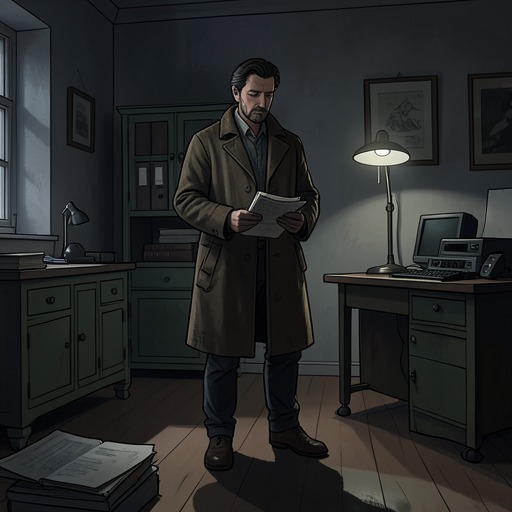
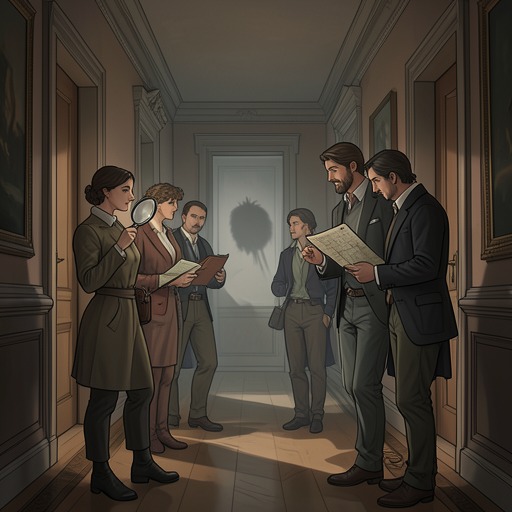
Later, investigators and residents assemble in the council chamber, and a search of the house extends into the night. Anthony Cade waits with Virginia Revel and Bill Eversleigh while an intruder enters through a window and examines a section of panelled wall. The room’s furnishings and architectural details become practical elements in the search: people hide behind an oak dresser and a suit of armour, while the suspected hiding place is sought in the walls.
Royal secrets and the hidden jewel
Battle explains that Nicholas IV and Queen Varaga had once visited England as guests of the late Marquis of Caterham. The Queen’s presence at Chimneys placed a royal visitor and an expert thief in the same history. Battle believes that the remarkable substitute used in the jewel scheme could only have been made by King Victor, and that the plan’s audacity also points to him. The affair was hushed up; Battle says the jewel did not leave England with the Queen, who hid it somewhere, although its location remained unknown.
The house’s long, unsuccessful searches do not resolve the mystery. Battle notes that Chimneys has been ransacked repeatedly, but argues that searching without knowing where to look is ineffective. The eventual solution shifts attention from the house’s interiors to its grounds. Anthony recognizes that Count Stylptitch’s device refers to a rose and goes to the rose garden; Mr Fish reaches the same conclusion. Taking the sundial as a starting point, the directions lead seven paces forward, eight to the left, and three to the right, to bushes of Richmond roses. The house has been searched, but nobody has thought to dig in the garden.
Anthony had planted a different clue by claiming that the diamond was among books in the library. That story was an invention intended to draw the woman seeking the jewel into the room. Mr Fish watched the terrace and gave a whistle when she arrived, allowing Anthony to expose the intruder. The false library lead and the real rose-garden directions show how Chimneys functions as more than a backdrop: its rooms and grounds provide distinct stages for deception, surveillance, and discovery.
Resolution in the grounds
The final chapter places the action at Chimneys at eleven on Thursday morning. A police constable, Johnson, is digging in the garden while friends and relations stand around the hole with a feeling likened to a funeral. The image brings the investigation back to the land around the house, where the concealed object can at last be sought. The rose garden, initially an overlooked part of the estate, becomes the decisive counterpoint to the repeated searches inside the building.
Across the story, Chimneys moves between roles without losing its past: a country residence, a tourist destination, a cover for political negotiations, a murder scene, and a storehouse of royal secrets. Its celebrated history makes it an obvious place for power to gather, while its corners, panelled walls, terrace, and garden allow private schemes to remain hidden—or to be uncovered when the search finally follows the right clue.